


You are here
German economists advise withdrawal of nation's gold from U.S. vaults
By Kate Connolly
The Guardian, London
Saturday, January 24, 2026
BERLIN -- Germany is facing calls to withdraw its billions of euros' worth of gold from U.S. vaults, spurred on by the shift in transatlantic relations and the unpredictability of Donald Trump.
Germany holds the world's second biggest national gold reserves after the United States, of which approximately E164 billion (L122 billion) worth -- 1,236 tonnes -- is stored in New York.
... Dispatch continues below ...
... ADVERTISEMENT ...
Buy metals at GoldMoney and enjoy international storage
GoldMoney was established in 2001 by James and Geoff Turk and is safeguarding more than $1.7 billion in metals and currencies. Buy gold, silver, platinum, and palladium from GoldMoney over the Internet and store them in vaults in Canada, Hong Kong, Singapore, Switzerland, and the United Kingdom, taking advantage of GoldMoney's low storage rates, among the most competitive in the industry. GoldMoney also offers delivery of 100-gram and 1-kilogram gold bars and 1-kilogram silver bars.
To learn more, please visit:
http://www.goldmoney.com/?gmrefcode=gata
Emanuel Monch, a leading economist and former head of research at Germany's federal bank, the Bundesbank, called for the gold to be brought home, saying it was too "risky" for it to be kept in the U.S. under the current administration.
"Given the current geopolitical situation, it seems risky to store so much gold in the U.S.," he told the financial newspaper Handelsblatt. "In the interest of greater strategic independence from the US, the Bundesbank would therefore be well advised to consider repatriating the gold."
Stefan Kornelius, the spokesperson for Friedrich Merz's coalition government, said recently that withdrawal of the gold reserves was not currently under consideration.
But Monch is only the latest in a string of economists and financial experts to argue that such a move would be in keeping with the greater strategic independence that Europe's largest economy has been seeking from the U.S. in recent months.
Michael Jager, the head of the European Taxpayers Association as well as the Association of German Taxpayers, has also said Berlin should make its move, arguing that the U.S.'s stated desire to seize Greenland should concentrate minds.
"Trump is unpredictable and he does everything to generate revenue. That's why our gold is no longer safe in the Fed's vaults," Jager told the Rheinische Post. "What happens if the Greenland provocation continues? ... The risk is increasing that the German Bundesbank will no longer be able to access its gold. Therefore it should repatriate its reserves."
Jager said he had written last year to the Bundesbank and the finance ministry, urging them to "bring our gold home."
Until recently the gold issue has been the preserve mainly of the far-right Alternative für Deutschland, which has repeatedly urged the return of the gold for patriotic reasons. But it has increasingly crept into the mainstream discourse.
Katharina Beck, the finance spokesperson for the opposition Greens in the Bundestag, has also spoken out in favour of relocating the gold bars, calling them an "important anchor of stability and trust" that "must not become pawns in geopolitical disputes."
However, Clemens Fuest, the president of the Institute for Economic Research and one of the country's most prominent economists, warned against such a move, saying it could lead to unintended consequences and would "only pour oil on the fire of the current situation," he told the Rheinische Post.
Germany's total gold reserves are worth almost E450 billion.
Just over half are held at the Bundesbank in Frankfurt am Main, 37% in the vaults of the U.S. Federal Reserve in New York, and 12% at the Bank of England in London, the global centre of gold trading. The Bundesbank says it regularly undertakes an audit of the supplies of gold it holds in storage.
Speaking last October at the International Monetary Fund's autumn meetings in Washington, the Bundesbank president, Joachim Nagel, assured attenders there was "no cause for concern" over the German gold held at the US Federal Reserve.
Frauke Heiligenstadt, the parliamentary group spokesperson on financial policy for the Social Democrats, junior partners in the government, said that while she understood concerns about the gold reserves, there was no need for panic.
"Germany's gold reserves are well diversified," she said. Because half of them are located in Frankfurt, "our ability to act is guaranteed." Having gold in New York made sense, she added, because "Germany, Europe, and the U.S. are closely linked in terms of financial policy."
But amid Trump's hardening rhetoric toward his Western partners, an increasing number of Merz's Christian Democrats have been speaking out in favour of relocation.
"Due to the Trump administration, the U.S. is no longer a reliable partner," Ulrike Neyer, a professor of economics at the University of Dusseldorf, told the Rheinische Post.
* * *
Support GATA by purchasing
Stuart Englert's "Rigged"
"Rigged" is a concise explanation of government's currency market rigging policy and extensively credits GATA's work exposing it. Ten percent of sales proceeds are contributed to GATA. Buy a copy for $14.99 through Amazon:
* * *
Help keep GATA going:
GATA is a civil rights and educational organization based in the United States and tax-exempt under the U.S. Internal Revenue Code. Its e-mail dispatches are free, and you can subscribe at:
To contribute to GATA, please visit:
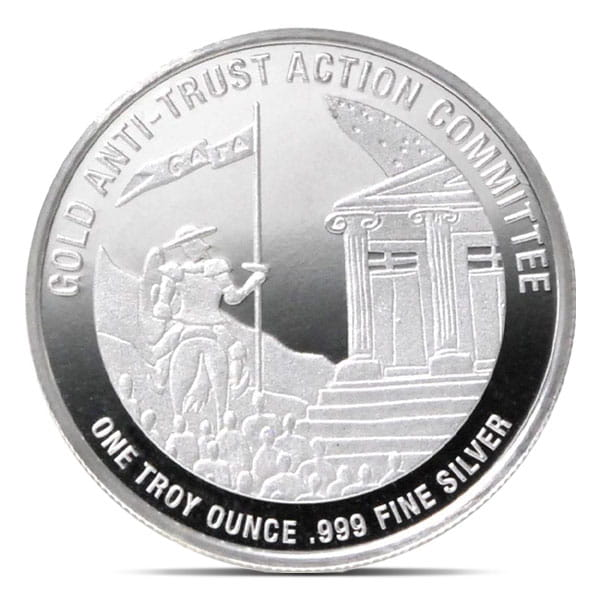
Donations of $500 or more will entitle the donor to a 1-ounce silver round commemorating GATA's work:
https://www.gata.org/sites/default/files/GATA-silver-round-front.png